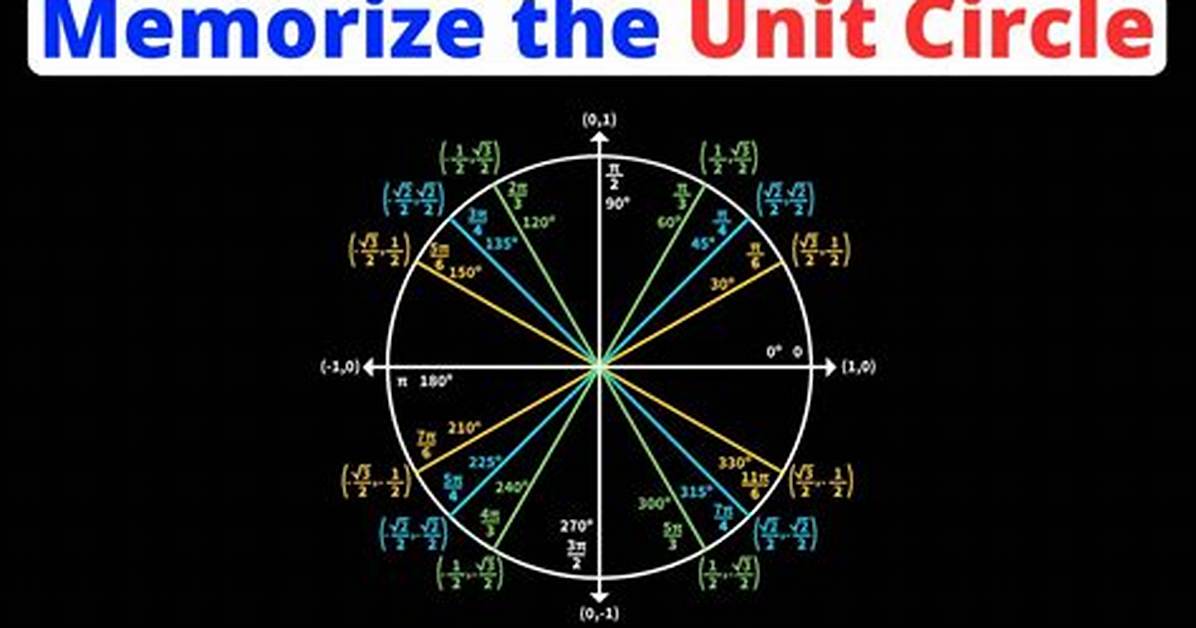
Once Quadrant I is secured, the remaining three quadrants require no new numbers. Every position on the circle is an exact mirror image across the x-axis, y-axis, or origin. Students resolve any angle outside the first quadrant using two clear steps: locating the reference angle and assigning the four quadrants signs.
A reference angle represents the acute distance between the terminal ray and the horizontal x-axis. For example, 150 degrees sits 30 degrees away from the 180-degree mark; its reference angle is 30 degrees. Consequently, the absolute values of its coordinates match the 30-degree coordinate set: (√3 / 2, 1/2).
To establish signs instantly, generations of precalculus students rely on the All Students Take Calculus mnemonic, reading counter-clockwise through quadrants I, II, III, and IV:
- Quadrant I (All): All trigonometric functions are positive.
- Quadrant II (Students): Only Sine is positive (x is negative, y is positive).
- Quadrant III (Take): Only Tangent is positive (both x and y are negative, making y/x positive).
- Quadrant IV (Calculus): Only Cosine is positive (x is positive, y is negative).
Applying this rule to 150 degrees in Quadrant II yields a negative cosine and a positive sine: (-√3 / 2, 1/2). Determining tangent values on the unit circle becomes an effortless secondary step: divide the sine numerator by the cosine numerator, completely ignoring the common denominator of 2.

