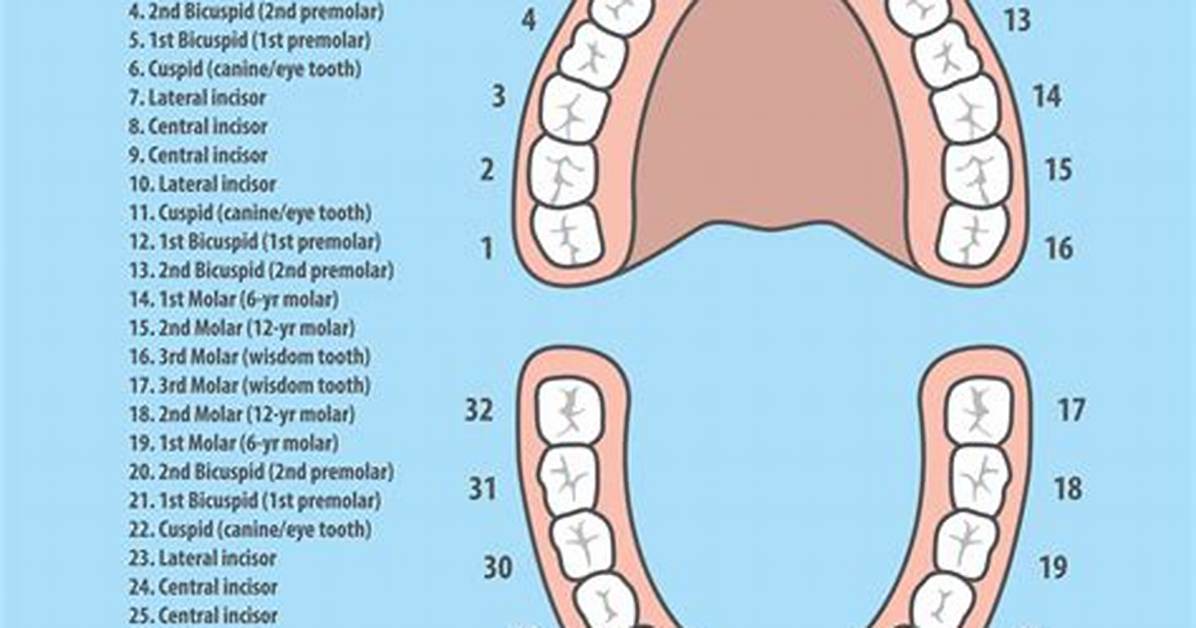
Adopted formally by the American Dental Association in 1968, the Universal Numbering System provides every adult tooth with an unalterable address. The count does not begin at the front of your smile. It starts at the extreme upper right: tooth #1 is your upper-right third molar, commonly known as a wisdom tooth. Moving sequentially along the maxillary arch, the upper jaw, the count travels toward the midline. Tooth #6 marks the prominent upper-right canine, while teeth #8 and #9 identify the two central incisors directly front and center.
The sequence continues leftward across your upper jaw, culminating at tooth #16, the upper-left wisdom tooth. The numbering then drops straight down to the mandibular arch, the lower jaw, beginning with tooth #17 at the lower-left third molar. Moving from left back to right along the bottom row, teeth #24 and #25 represent the lower central incisors. The journey concludes at the lower-right third molar, designated as tooth #32.
Wisdom teeth numbers are fixed at the extremities: 1, 16, 17, and 32. If an oral surgeon removed all four of your third molars during your teenage years, your mouth does not compress into a 1-to-28 count. Tooth #2 does not become tooth #1. The physical absence of a tooth leaves an empty address on your clinical chart, preserving anatomic accuracy for life.

